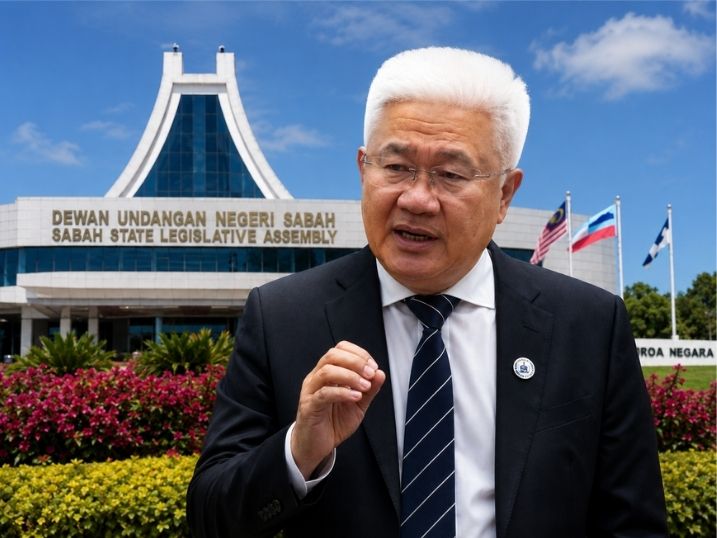
KOTA KINABALU: July 22, 2026 – The assemblyman for Kapayan, Datuk Chin Tek Ming, has demanded that the state government clarify the actual amount of the RM1.5 billion interim special grant that has been transferred to Sabah’s coffers, and provide a full breakdown for a proposed supplementary expenditure of RM1.6126 billion.
Speaking during the Sabah State Legislative Assembly sitting on Tuesday, Mr Chin questioned exactly how much of the RM1.5 billion Interim Special Grant had so far been disbursed to the state government. He insisted that the administration must reveal the sum credited to its accounts, the dates of receipt, and which ministries had received the allocated funds.
According to him, the people of Sabah have a right to know the true status of the allocation, as it concerns the interests of the state and the use of public money.
“I am not asking about press statements. I am not asking about media releases. I am not asking about promises,” he stressed. “I am asking about the money that has actually entered the Sabah state government’s account.”
Prime Minister Datuk Seri Anwar Ibrahim announced the increase in Sabah’s Interim Special Grant to RM1.5 billion during the Kaamatan Festival celebrations on 30 May. According to Deputy Finance Minister Liew Chin Tong, the increase will not reduce the state’s ceiling for operational and development allocations under this year’s Federal Budget.
To date, Sabah has received RM600 million of the Interim Special Grant from the federal government, which was paid on 12 June. Assistant State Finance Minister Datuk Seri Mohd Ishak Ayub previously informed the house that several rounds of correspondence between the federal and state governments took place on 9, 19 and 26 June, and that the state government has requested the remaining RM900 million to be disbursed within this year.
In addition, Mr Chin asked the government to clarify whether the proposed supplementary expenditure of RM1.6126 billion is linked to the RM1.5 billion federal allocation.
He said that if the funds are being used, the government must state the amount involved; conversely, if they are not, the actual source of financing for the additional spending must also be explained to the house.
Mr Chin stressed that the state government must provide a comprehensive explanation of the proposed supplementary allocation, including who will benefit from it and what tangible outcomes the public can expect.
He also argued that the government must clarify why the 2026 Budget, passed in November last year, was no longer sufficient, and whether this stemmed from miscalculations, unplanned expenditure, or weaknesses in financial planning.
“When the government comes to the house asking for such a large supplementary sum, it bears the responsibility to provide a full explanation. This house is not a rubber stamp,” he said.
He added that every ringgit of public money spent must be accounted for transparently, as the State Legislative Assembly’s role is to ensure that government spending is carried out prudently.
According to him, the government must also answer the questions raised with facts, figures and records, so that the public understands the rationale behind the supplementary expenditure proposal.
The state government is seeking an additional RM1.6126 billion to finance its operating expenditure until the end of the year. The supplementary allocation covers six main categories: contributions to statutory funds amounting to RM856 million (53%), operating expenditure RM278 million (17%), investments RM210 million (13%), administrative expenditure RM162 million (10%), domestic grants RM93 million (6%), and special allocations RM13 million (1%).
State Finance Minister Datuk Seri Masidi Manjun said the bulk of the proposed supplementary allocation is for contributions to statutory funds, which does not involve cash outflow, but is instead an accounting adjustment carried out via internal “book transfers”.