
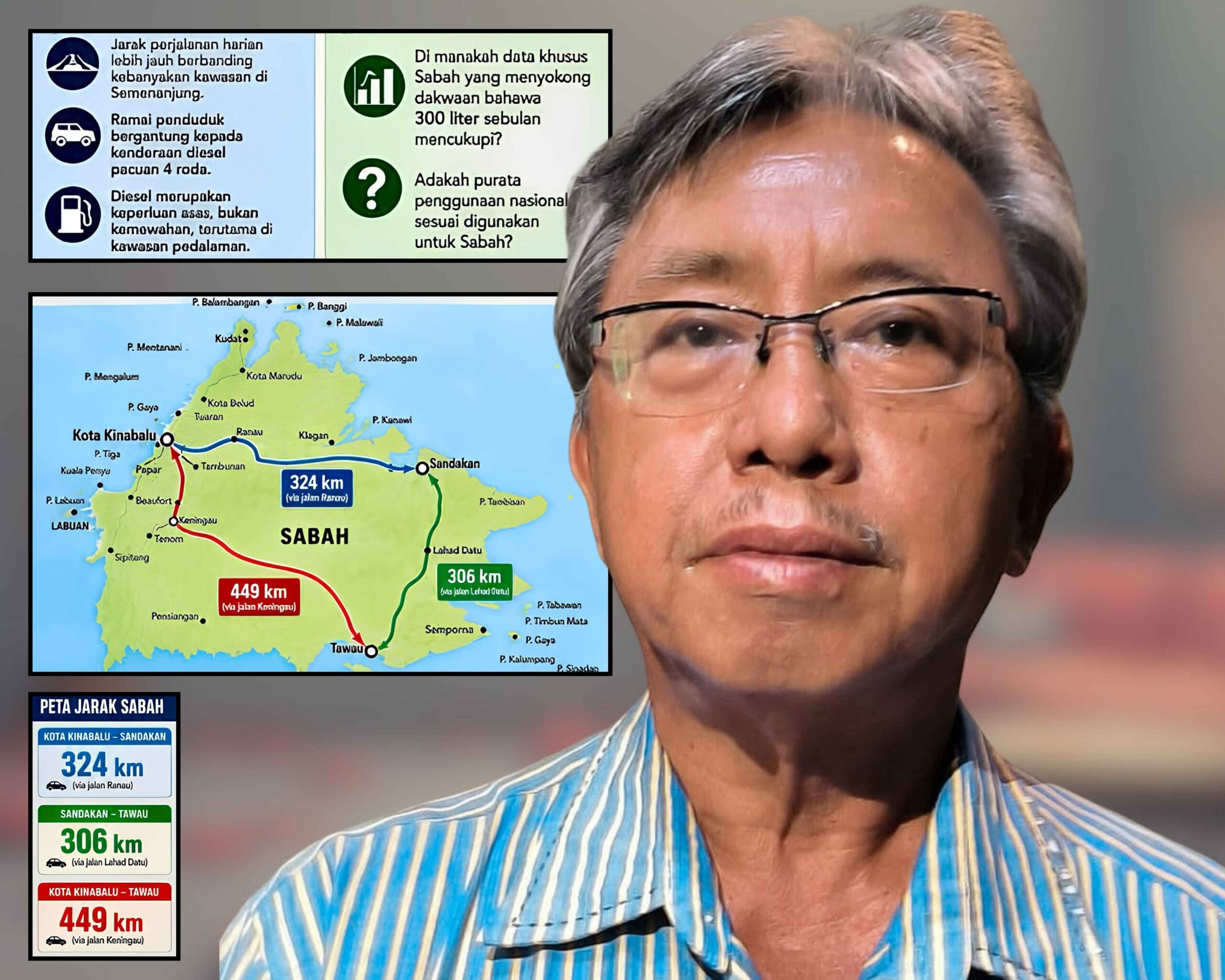
KOTA KINABALU: Julai 1, 2026 – STARSABAH has questioned the federal government’s rationale for maintaining the Budi Madani diesel subsidy quota which took effect today, alleging the policy is based on national statistics that fail to reflect the true situation in Sabah.
STARSABAH Information Chief Anuar Ghani, in a statement on June 27, said the government must disclose Sabah-specific data to prove that the 300-litre monthly quota is sufficient for consumers in the state.
He was responding to Finance Minister II Datuk Seri Amir Hamzah Azizan’s previous statement that 95% of diesel users consume less than 300 litres per month, making the existing quota adequate for the majority of Malaysians.
“That statement may sound convincing in Putrajaya, but in Sabah it raises a far more important question – where is the Sabah data?” Mr Anuar asked in a statement on Saturday.
“If the federal government is using the national average to defend a policy that directly affects the people of Sabah, then it is repeating the same mistake that has disappointed Sabah for decades – making decisions about Sabah without truly understanding Sabah,” he stressed.
According to Anuar, Sabah’s geography, infrastructure, economy and reliance on diesel vehicles are vastly different from Peninsular Malaysia. He argued that the national average is therefore an inappropriate basis for formulating policy that impacts Sabah.
He drew a parallel to a written parliamentary reply on February 26 by Deputy Works Minister Datuk Seri Ahmad Maslan, which classified the Ranau-Tamparuli road as having a Level of Service (LOS) A rating, despite frequent reports of severe congestion on that route.
“He said the road could still accommodate existing traffic flow, whereas road users travelling between Sabah’s west and east coasts via Kundasang and Ranau often face jams of up to five hours, particularly on weekends and public holidays,” Mr Anuar said.
He said the example illustrated how federal-level assessments frequently fail to capture the real situation in Sabah.
Anuar explained that many Sabahans are forced to undertake long journeys daily for work, farming, transporting goods and accessing basic services, especially in rural and interior areas. There, diesel-powered four-wheel-drive vehicles are a necessity, not a luxury.
“The government expects the people of Sabah to trust that statistics compiled at the national level automatically reflect reality in districts such as Nabawan, Pensiangan, Tongod, Kalabakan, Telupid, Ranau and Paitan,” he said.
He also noted that a journey between Kota Kinabalu, Sandakan and Tawau covers approximately 630 kilometres one-way, with fuel consumption reaching around 100 litres.
Anuar questioned whether the federal government has data on the number of diesel users in Sabah who exceed the 300-litre quota, including farmers, fishermen, rural entrepreneurs and interior contractors.
“If the government has these figures, it should publish them. If not, on what basis does the government claim this policy is fair for Sabah?” he asked.
While acknowledging that the subsidy rationalisation is intended to curb leakages and smuggling, he stressed that law-abiding Malaysians should not have to bear the consequences of enforcement failures.
Anuar concluded firmly: “The people of Sabah are not asking for special treatment, but rather for fair and just consideration in the implementation of federal policies.”