
By David E.
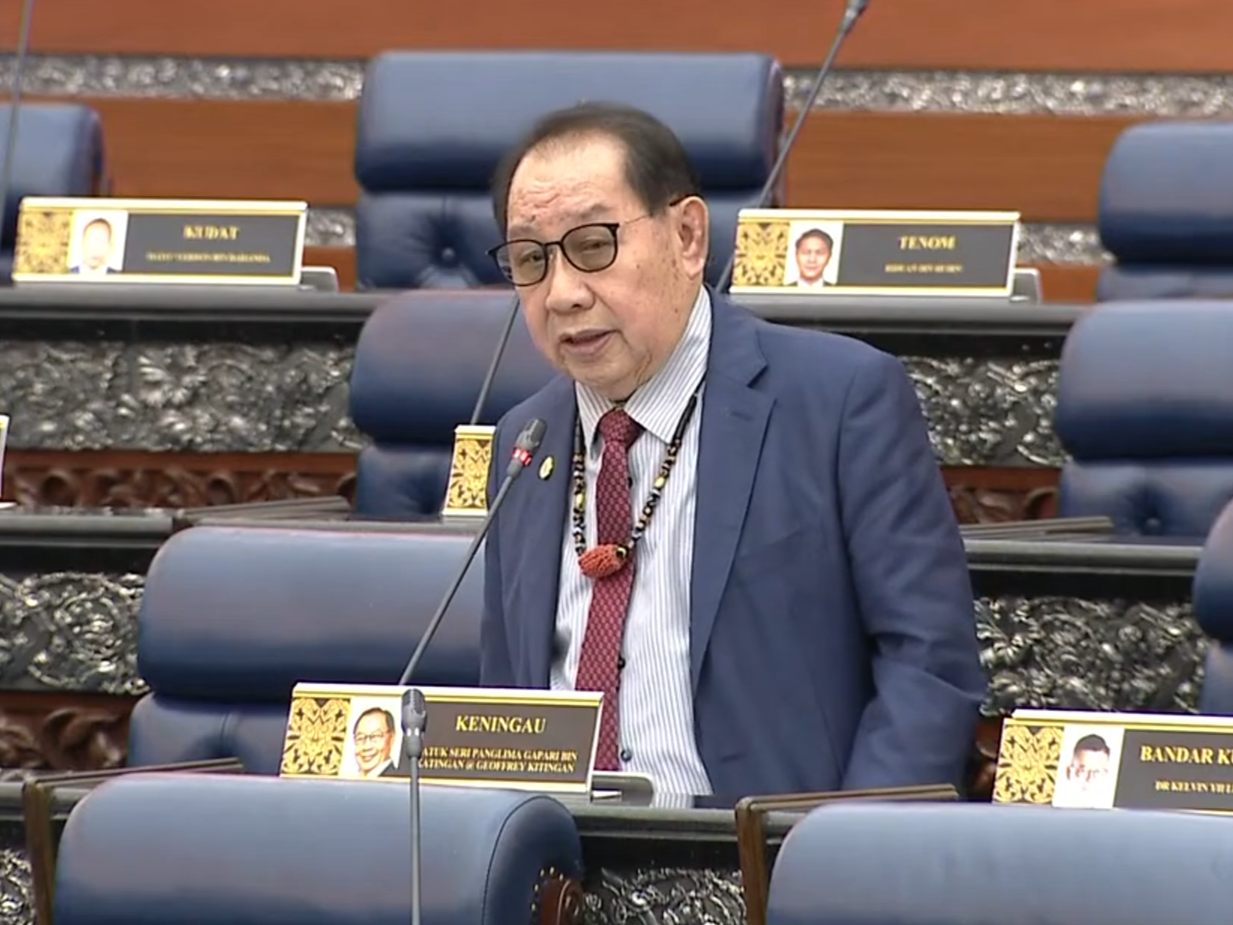
KUALA LUMPUR: 21 October 2026 – Keningau Member of Parliament Datuk Seri Dr Jeffrey Kitingan raised the issue of unfair development allocation and Sabah’s revenue rights in the 2027 Budget debate in the Dewan Rakyat yesterday. He proposed a new formula allocating 25 per cent of development allocation each to Sabah and Sarawak.
According to him, the RM18.7 billion allocation announced by the Prime Minister for Sabah actually covers federal expenditure including civil servant salaries, not development allocation.
“Sabahans thought this was a ‘durian windfall’, but upon closer scrutiny, it is our hopes that have crumbled,” he said.
He said the actual development allocation for Sabah and Sarawak was only RM7 billion, with Sarawak receiving RM6.2 billion.
“This means development distribution is still based on the old formula and remains ‘Malaya-centric’ – 85 per cent for Peninsular Malaysia, 8 per cent for Sabah and 7 per cent for Sarawak – even though those most in need of development are Sabah and Sarawak, which remain underdeveloped.
“Sabah is the most underdeveloped region, the poorest, and the most backward in terms of infrastructure – from education to doctors who refuse to serve in Sabah,” he said.
He said there were five causes of Sabah’s backwardness. First, development allocation distribution was unfair because more than 80 per cent was still for the already developed Peninsular Malaysia.
Second, the failure to implement the Malaysia Agreement 1963 (MA63). The government failed to fulfil financial revenue rights, leaving Sabah poor and dependent on the federal government.
He said Sabah had been denied at least RM20 billion a year since 2021 due to the failure to fulfil the 40 per cent revenue right.
“Revenue collected from Sabah is no less than RM50 billion a year. With a 60/40 split, Sabah’s loss is RM20 billion a year. From 2021 to 2026, RM120 billion has been denied to Sabah,” he said.
Kitingan referred to the Kota Kinabalu High Court decision in October 2025 recognising the 40 per cent right.
“If an appeal is filed, it will be interpreted by some quarters as disrespecting the Constitution, not wanting to return the 40 per cent revenue to Sabah and not fulfilling Sabah’s rights,” he said.
He proposed the establishment of the MA63 Revenue Tracking System (MERTS) mechanism using artificial intelligence technology to monitor revenue distribution automatically.
Third, constitutional violations.
“State rights have been encroached upon, especially oil and gas rights which actually belong to Sabah and Sarawak. They were taken through the Petroleum Development Act 1974, which is deemed unconstitutional because land and natural resources are listed in the State List, not the Federal List,” he said.
“After the Vesting Order 1975 and the oil handover agreement of 14 June 1976, Sabah only received five per cent compared with the previous 12.5 per cent royalty – a loss of 7.5 per cent. Sabahans are asking: what benefit do we get from being in Malaysia?” he said.
Kitingan proposed a new development allocation formula: 50 per cent for Peninsular Malaysia, 25 per cent for Sabah and 25 per cent for Sarawak.
Fourth, political interference in Sabah was too rampant.
“The Palace doors are often controlled on the instructions of Kuala Lumpur leaders. The Constitution was once set aside because Kuala Lumpur wanted to manage the rotation of the Chief Minister every two years – causing Sabah’s administration to be damaged,” he said.
He also raised the IC Project which he claimed was introduced to change Sabah’s demographics, including “rented” voters, and claimed that in 1994 the project brought down a political party.
“I myself was once summoned by the Prime Minister and offered to be sworn in as Chief Minister – but I declined because I was not a party leader and the action was unfair morally and legally. I did not want to be a Kuala Lumpur puppet,” he said.
Finally, touching on the overall impact, Kitingan said the political interference had occurred and must stop, while referring to the wisdom of Brunei and Singapore which he said were prosperous without Malaysia.
“The time has come for us to correct Malaysia,” he said.
He also raised the issue of 35 per cent of parliamentary seats for Sabah and Sarawak as a constitutional safeguard as enshrined in the IGC Report, the postal voting rights of Sabahans in Peninsular Malaysia, and the call for political parties from Kuala Lumpur not to contest in the 17th Sabah State Legislative Assembly Election on 29 November 2025.
Among other proposals raised by Kitingan were priority for 75 per cent of the Rural Road Project and Rural Basic Infrastructure allocation worth RM2.3 billion and RM3.3 billion for Sabah and Sarawak, and approval of the Hardcore Poor Housing Project (PPRT) for Keningau and Tenom.
He also requested RM7 million to upgrade Taman Tukad Sinurambi in Tambunan as an ecotourism icon for the district. His proposals included the construction of 3,000 steps, seven mukim house stops to promote agricultural commodities, environmentally friendly landscaping, a cultural centre and a para-gliding activity centre.
Closing the debate, Kitingan raised the logistics issues faced by MPs from Sabah and Sarawak. He stressed that their needs were different and deserved special consideration because they had to fly and face various challenges to get to Kuala Lumpur.
“Our needs are different and should be given due consideration,” he said.
The 2027 Budget is worth RM459.84 billion, the largest to date, and still shows a deficit despite increased revenue.
– TV Sabah