By Roodwill
KOTA KINABALU: 5 June 2026 – Eleven years. Long enough for many memories to fade, yet for Sabah, the events of June 5, 2015 remain etched as one of the darkest tragedies in the state’s history.
At 7.15am that morning, the earth beneath Ranau shook violently. A 5.9-magnitude earthquake struck with its epicentre about 15 kilometres north of the district at a depth of 10 kilometres. The tremor lasted only 30 seconds, but it was powerful enough to be felt not only in Ranau, but also in Kota Kinabalu, Tuaran, Kota Belud, Keningau, Sandakan, Tawau, Labuan, and as far as northern Sarawak and Brunei.
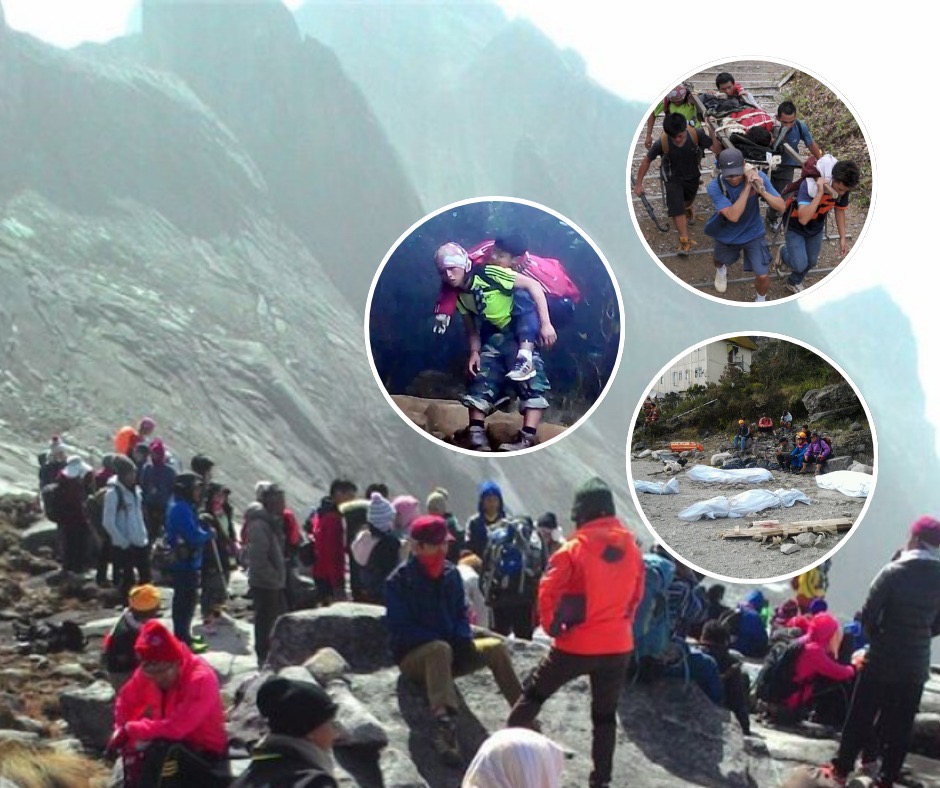
In an instant, the tranquillity atop Mount Kinabalu turned into a nightmare. Massive rockfalls tore through parts of the summit area and climbing route, claiming 18 lives.
Names That Will Never Be Forgotten
Those who perished were more than statistics. They were individuals with dreams, families, and stories of their own. Four mountain guides and 14 climbers from Malaysia, Singapore, Japan, and China lost their lives that day.
Mountain Guides
- Joseph Solungin
- Ricky Masirin
- Robbie Sapinggi
- Valerian Joannes
Climbers
- Ameer Ryyan Bin Mohd Adeed Sanjay
- Emilie Giovanna Ramu
- Lim Choon Seong
- Loo Jian Liang Terrence Sebastian
- Lu Qi
- Masahiro Ozaki
- Matahom Karyl Mitzi Higuit
- Mohammad Ghazi Bin Mohamed
- Muhammad Daanish Bin Amran
- Muhammad Loqman Bin Abdul Karim
- Navdeep Singh Jaryal
- Rachel Ho Yann Shiuan
- Sonia Jhala
- Wee Ying Ping Peony
Many of the victims were students and teachers from Singapore who were taking part in a school climbing programme. The tragedy left deep scars on the victims’ families, the mountain guide community, Kinabalu Park staff, and the people of Sabah.
Amid Tragedy, Courage Shone Through
Yet from the devastation emerged stories of extraordinary bravery.
Sabah’s mountain guides, despite losing friends and colleagues, pressed on. As aftershocks continued and climbing routes lay in ruins, they became the backbone of the rescue effort.
Facing freezing temperatures, limited food and water supplies, and the constant threat of further rockfalls, they helped evacuate injured climbers and guided those stranded on the mountain to safety.
Their courage and selflessness helped save countless lives.
A Changed Landscape, A New Awareness
The earthquake also altered the face of Mount Kinabalu.
One of its iconic rock formations, known as Donkey’s Ears, was damaged by the rockfalls. The Poring Hot Springs turned murky, while 23 school buildings across six districts sustained damage.
On the first night alone, three aftershocks were recorded between 9pm and 11.30pm. By June 23, 2015, a total of 90 aftershocks had been detected in the Ranau area.
The earthquake remains one of the strongest ever recorded in Malaysia and the most significant to strike Sabah since 1976.
Strengthening Safety and Preparedness
In the years that followed, major improvements were introduced.
Malaysia’s seismic monitoring network was strengthened with additional earthquake detection stations, particularly in Sabah. Safety measures on Mount Kinabalu were also enhanced through improved emergency procedures, expanded safety training, and the establishment of the Mountain Search and Rescue (MOSAR) team.
Made up of experienced and highly trained mountain guides, MOSAR has become a key component of the mountain’s safety system and remains on standby to respond to emergencies whenever needed.
More Than a Disaster, A Lasting Legacy
Today, Mount Kinabalu’s landscape has largely recovered. Thousands of climbers once again make the journey to its summit each year, drawn by its breathtaking beauty.
Yet for those who lost loved ones, for the mountain guides who still remember the cries echoing across the heights, and for Sabah itself, the memory of June 5, 2015 has never faded.
The Kinabalu earthquake was more than a natural disaster. It was a story of loss, courage, and resilience a testament to a community that found the strength to rise from one of the most difficult moments in its modern history.
Eleven years later, the 18 lives lost may be gone, but their names and sacrifices live on not only on memorial plaques, but in every safety measure now in place, in every MOSAR training exercise, and in the collective memory of a state that refuses to forget.
Because they will never be forgotten.