by David E.
RANAU: Nov 6, 2026 – Beneath the cool mist-shrouded highlands of Ranau, a group of smallholders in Kampung Toboh Lama have proven something remarkable: their land is capable of producing high-value coffee on par with yields from around the world.
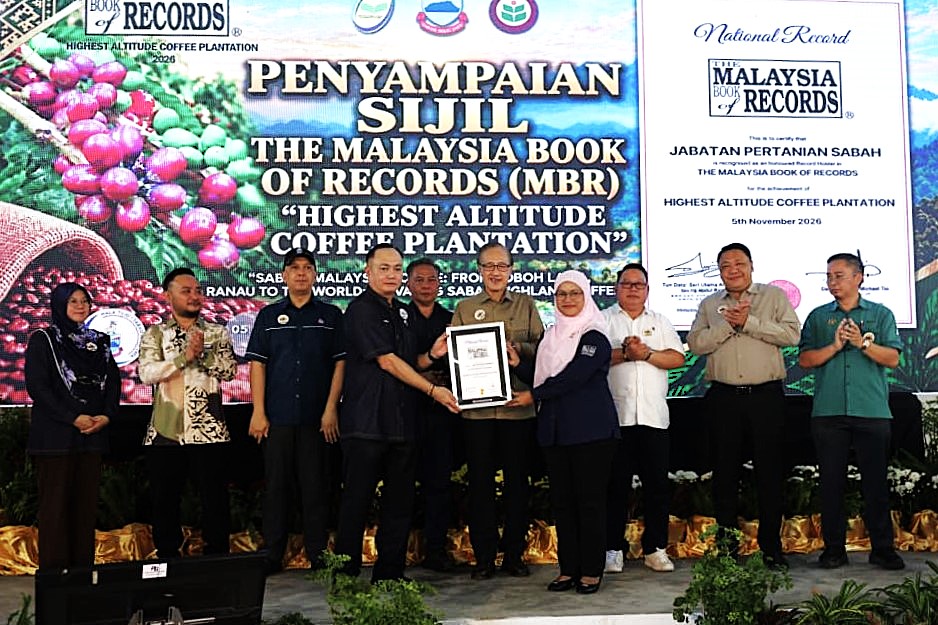
That success has now been officially recognised. The launch ceremony of The Malaysia Book of Records (MBR) “Highest Altitude Coffee Plantation” 2026 category in the village recently made Ranau the highest-altitude coffee-planting location in the country.
However, local residents view the recognition as proof of smallholders’ ability to produce premium-grade products, not merely an entry in a record book.
“As a son of Ranau, I want this success to bring real economic benefits to the people. Our farmers must not see themselves merely as farm producers, but as entrepreneurs who have a place in the premium coffee industry chain,” said Deputy Chief Minister II, who is also Sabah State Finance Minister, Datuk Seri Panglima Haji Masidi bin Manjun, when officiating the ceremony.
According to Masidi, the potential of Ranau’s coffee industry is immense. Based on figures shared at the Malaysia Cafe Expo 2025, the domestic coffee market is valued at approximately RM4.4 billion with over 6,400 cafes nationwide. Specialty coffee from Ranau is reported to fetch between RM50 and RM65 for a 250-gramme pack.
“These figures show the value that can be generated if quality, supply and marketing are well managed,” he said.
He identified three key opportunities for Ranau. First, increasing production and developing the value chain from cultivation, processing and roasting through to packaging and marketing.
“We want more of this coffee’s value to remain in the hands of local operators,” he stressed.
Second, nurturing more young agropreneurs. Ranau’s youth need to see the coffee industry as a viable career, including in roasting, brand development and digital marketing.
“It is not impossible that one day we will have a Sabah highland coffee brand or cafe chain known nationwide,” he said.
Third, linking the coffee industry with tourism through the proposed “Coffee Trail Ranau”. Visitors would have the opportunity to experience highland coffee farms, observe the production process and savour local coffee firsthand.
“This can open up additional income for the community,” he said.
In line with the Sabah Maju Jaya 2.0 direction, Masidi wants the Ministry of Agriculture, Fisheries and Food Industry together with the Department of Agriculture to prepare an action plan for the development of Ranau’s coffee industry. Priorities include post-harvest facilities, training and mechanisation, research to maintain coffee quality, and wider marketing networks.
At the same time, operators need to be guided to meet standards such as myGAP or myOrganic where appropriate. Consistent quality and certification are believed to help Ranau coffee penetrate premium markets, including international markets.
The ceremony also witnessed the opening of the Kampung Toboh Lama Multipurpose Hall. Masidi hoped the facility would be fully utilised for meetings, youth activities, culture, sports and community programmes.
“Economic development and community well-being must move in tandem,” he said.
He stressed that the true measure of success is not merely Ranau’s name being recorded in the record book.
“True success is more farmers increasing their income, young people gaining job opportunities and village communities enjoying a better life. That is the spirit of development we want under Sabah Maju Jaya,” he said.
Also present were Sabah Agriculture, Fisheries and Food Industry Minister Datuk Haji Jamawi bin Jaafar; Sabah Finance Ministry Permanent Secretary Datuk Mohd. Sofian Alfian Nair; Sabah Agriculture, Fisheries and Food Industry Ministry Permanent Secretary Datuk Ts. Haji Jifrin Haji Mohamad; Sabah Department of Agriculture Director Tuan Jackson Ronald Jaimi; and Ranau District Officer Tuan Herry Awit; representatives of The Malaysia Book of Records panel; department heads; community leaders; media partners and the entire Kampung Toboh Lama community.
Source: MOF