By David E.
KUCHING: July, 13 2026 — The President of the Homeland Solidarity Party (STAR) and the Borneo Dayak Forum (BDF), Datuk Seri Panglima Dr Jeffrey G. Kitingan, has stressed that political unity between Sabah and Sarawak is the key to successfully claiming the rights enshrined in the Malaysia Agreement 1963 (MA63), while proposing the formation of a “Borneo Bloc” in Parliament to strengthen the Borneo voice at the federal level.
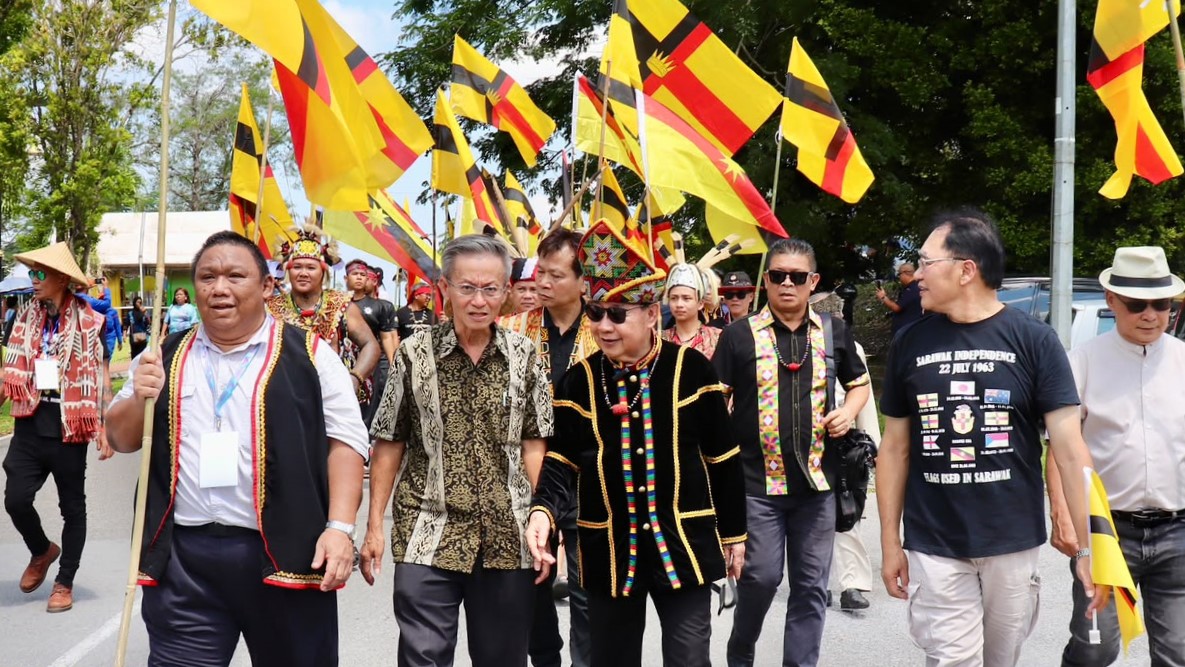
In his address at the Sarawak Day 2026 celebration at Tasik Biru, Bau, on Wednesday, Dr Jeffrey, who is also the Member of Parliament for Keningau and the State Assemblyman for Tambunan, described the unity demonstrated by Sarawak as an example that Sabah should follow.
“I am impressed with Sarawak because it is politically united. And this is what we need to successfully claim our rights, because the rights of Sabah and Sarawak are essentially the same,” he said.
He was present together with more than 1,000 participants in the 722 Walk programme and also praised the Sarawak Government for gazetting 22 July as a public holiday starting in 2016, making it the first state in Borneo to officially recognise its independence day.
Dr Jeffrey reminded the audience that there are three important dates in the history of the formation of Malaysia that are often overlooked: 22 July 1963 — Sarawak Independence Day, when Sarawak gained self-governance from the British; 31 August 1963 — Sabah Independence Day, declared by the North Borneo Legislative Council on 8 August 1963; and 16 September 1963 — the official formation day of Malaysia.
“Sarawak Day has become a reality and is celebrated by the government every year… We in Sabah also gather every year to promote Sabah Day, and thankfully, four years ago I succeeded in having Sabah Day officially recognised,” he said.
He described the date of 31 August 1963 as “a missing piece of history” for Sabah, given that Sabah’s independence on that date was never officially celebrated for 60 years.
In his impassioned speech, Dr Jeffrey elaborated on the critical difference between the Malaysia Agreement signed on 9 July 1963 and the Malaysia Declaration on 16 September 1963 — a difference that, he said, is the source of the feeling of being “cheated” among the people of Sabah and Sarawak.
“In Article 1 of the Malaysia Agreement, it says North Borneo, Sarawak and the state of Singapore shall be federated with the existing states of the Federation of Malaya, and the federation shall be called Malaysia. This means, according to the Malaysia Agreement, no new country was created — they just changed the name,” he asserted.
He explained that on 9 July 1963, when MA63 was signed, Sabah and Sarawak were still British colonies. This differs from the Malaysia Declaration on 16 September 1963, which recognises Sabah and Sarawak as “states” that had already achieved independence and were “federated” with Malaya.
“In the Malaysia Declaration, it says ‘the state of Sabah, the state of Sarawak’ are federated with Malaya… This means Sabah and Sarawak, which had already become states and achieved independence, were federated with Malaya.”
He stressed that this difference is what needs to be “corrected in our history.”
Dr Jeffrey also reminded of the 1976 constitutional amendment that downgraded Sabah and Sarawak’s status from equal partners to ordinary states — Sabah becoming state number 12 and Sarawak state number 13 on identification cards.
“They tried to downgrade our position back to the status of states in the Peninsula, to implement Article 1 of the Malaysia Agreement, not what was declared on 16 September.”
In the same year, he said, the federal government also took over oil and gas resources through the Petroleum Development Act 1974 (PDA 74).
“I agree with brother Francis, brother Raymond that this oil and gas is ours. It is already stipulated in the Constitution — land including natural resources belong to the states of Sabah and Sarawak.”
However, he praised the efforts of Sarawak’s leadership under Tun Junaidi and Premier Abang Johari in successfully restoring Sabah and Sarawak’s status as equal partners through the amendment to Article 1(2) of the Federal Constitution in 2018.
“Congratulations to Sarawak once again.”
In the context of financial rights claims, Dr Jeffrey explained the difference between Sabah and Sarawak:
“Sabah has a formula to claim 40% of revenue — Sarawak does not. But they are also eligible to claim, because Sarawak was given the option to receive a fixed amount, and that fixed amount can be negotiated.”
He revealed that to this day, the 40% payment has not been made even though 63 years have passed since Malaysia was established.
“The court has made a decision and has ordered this to be finalised… The court has also ruled that interim payments are not acceptable as a substitute for the 40% — interim payments have been declared null and void and unlawful.”
One of the most significant calls in Dr Jeffrey’s speech was the proposal to establish a united political bloc for Sabah and Sarawak in Parliament.
“Speaking of unity, I think in terms of political power and in this Parliament, Sabah and Sarawak should unite to make the Borneo Bloc a fundamental statement for fighting for our shared interests and rights.”
He proposed that GPS (Gabungan Parti Sarawak) be given an additional ‘S’ to make it a coalition of Sabah-Sarawak parties.
“GPS has already succeeded. I suggest adding another ‘S’ — a Sabah-Sarawak parties coalition under the name of the Borneo Bloc, so that in Parliament we will have a single voice.”
According to him, Sabah and Sarawak together hold 56 parliamentary seats — Sabah 25 and Sarawak 31. If united, this would make the bloc among the largest in the Dewan Rakyat, comparable to the major parties in the Peninsula.
“If we unite, we will have at least 57 seats — the largest, because currently the largest only has 46.”
Dr Jeffrey also criticised the imbalance in development allocations between the Peninsula and Sabah and Sarawak.
“From a 100 billion development budget, the central government only gives us Sabah and Sarawak less than about 13% — meaning we get the leftovers. Almost 87% to 90% of development allocations are in the Peninsula.”
He emphasised that Sabah and Sarawak — which have great potential for development and remain poor — should receive larger allocations.
“Why not reverse it — give more to Sabah and Sarawak for the development budget, so that we can develop our potential, solve our poverty and underdevelopment problems? When Sabah and Sarawak progress, Malaysia progresses too.”
Dr Jeffrey also demanded that the parliamentary seat allocation for Sabah and Sarawak be restored to the original ratio of 35%, compared to 65% for the Peninsula.
“Our parliamentary seats originally comprised 35% — 60-65% in the Peninsula because there are many states there, and 35% for Sabah and Sarawak.”
He explained that in discussions on the formation of Malaysia, the criteria for Sabah and Sarawak were different — not just population, but also land area and development potential.
“Some say ‘but your population is small’ — our population being small does not mean our problems are small. In fact, our problems are bigger. In the Malaysia Agreement, it says do not just look at population, but also consider the size of Sabah and Sarawak and their development potential.”
Concluding his speech, Dr Jeffrey expressed his love for Sarawak and recalled the struggle shared over more than a decade.
“I am a Borneo person — in Kalimantan, Indonesia too, I travel around. Every year I come to Kuching actually and celebrate together with friends to raise the Sarawak flag at Padang Merdeka.”
He recalled the early days of the struggle in 2010, when the annual parade began with only a handful of participants — and was dispersed by police — before growing into a large-scale celebration attended by thousands.
“In 2014, the parade had grown larger — some walked, some rode motorcycles, some came by car. And at that time I was surprised because the police did not disperse us anymore, instead police officers walked alongside helping us.”
He also invited all attendees to the World Indigenous Peoples Day celebration in Sabah from 21 to 23 August.
“Two years ago we held it here in Kuching, last year in Palangkaraya, this year Sabah is the host. Come in large numbers.”
Dr Jeffrey ended his speech with words of unity:
“This independence day is the most important day in history, because on independence day we regained the power to govern ourselves in Sarawak… On behalf of our friends in Sabah, I convey to the leaders of Sarawak — Happy Sarawak Day 2026.”
Sarawak Day is celebrated on 22 July every year to commemorate the moment Sarawak gained self-governance on 22 July 1963, following the end of British colonial administration. The date was declared a state public holiday starting in 2016 under the leadership of the then Chief Minister, the late Tan Sri Adenan Satem.
Sabah achieved independence on 31 August 1963, but the date was only officially gazetted as Sabah Day on 5 June 2024.
MA63, signed on 9 July 1963, contains 20 points raised by Sabah and 18 points by Sarawak to protect state interests, rights and autonomy following the formation of Malaysia.