
By Leonard Alaza & Vincent Tan
Semporna’s turquoise waters and stilted coastal homes once framed some of Malaysia’s most photographed reefs.
In a 2023 interview published by Sabah leading newspaper Daily Express, German Ambassador to Malaysia Dr Peter Blomeyer said he was appalled upon seeing the waste situation first-hand.
“The amount of plastic I saw in Semporna and in the islands are unbelievable. I’ve never seen anything like it.”
In September 2025, a British travel vlogger released clips of Semporna’s waste pollution and branded the town “the dirtiest in Asia”. The clip went viral, forcing an uncomfortable national conversation that even federal housing and local government minister Nga Kor Ming openly criticised Semporna’s long time MP Mohd Shafie Apdal, a former Sabah chief minister, over Semporna’s persistent waste management failures.
The criticism was particularly touchy with Sabah’s state elections around the corner, as well as Semporna’s waste problem threatening Malaysia’s upcoming Visit Malaysia Year 2026 tourism push.
Beneath its postcard beauty, Semporna, on Sabah’s East Coast and the closest jump-off to diving spots such as Sipadan and Mabul, faces multiple crises, from plastic pollution, to fish bombing and coral bleaching.
In 2023 alone, despite extensive patrols, authorities recorded over 600 blasts that destroyed fish stocks and left once-vibrant coral reefs in ruins. Meanwhile tonnes of waste continue to wash ashore on islands like Mabul, Kulapuan and Larapan. Enforcement is weak, habits hard to change.
Yet a quiet revolution is stirring. Semporna’s youth are rising to defend the sea that defines their lives, fighting not just pollution but indifference itself. For them, the hardest task isn’t saving the reefs, it is changing minds, often one household at a time.

Siti Rugaiyah Ghadafi, from Kalapuan Island (left) planting spider frames to help restore damaged coral reefs near her island home, with the aim that the effort would help bring the fish back so that her community will have a sustainable source of food and income.
One Reef at a Time
Twenty-four-year-old Mazni Jakarullah, a Bajau Kubang woman from Larapan Island is part of this wave of change. Mazni is a trained diver and member of the Larapan Marine Conservation Group, a community organisation set-up with assistance from non-governmental organisation Reef Check Malaysia. Mazni patrols reefs, plants coral and leads clean-ups while urging her neighbours to see the sea as more than a resource.
“Ultimately, we’re trying to change mindsets, from apathy to empathy,” she says. “People must see how connected they are to the environment.”
That is rarely easy. Elders sometimes scold the youths for interfering with trusted methods – blast fishing and careless dumping are long-standing habits tied to survival. To earn their trust, Mazni instead leads by example, by showing how small actions from waste-sorting to protecting reefs can secure future livelihoods.
Supported by short-term NGO training and sheer passion, Mazni balances her conservation work with family life. “Sometimes it’s exhausting,” she admits. “But if we don’t act, who will?”
Turning volunteer work into sustainable livelihoods
Knowledge is Mazni’s shield. Training from NGOs and exposure to global environmental issues online have equipped her generation with new perspectives and tools. Yet most conservation work in Semporna remains unpaid and dependent on short-term support.
Personally, Mazni has to balance her patrols and nursery work with family responsibilities. Recently married, she knows that passion alone cannot sustain these efforts forever.
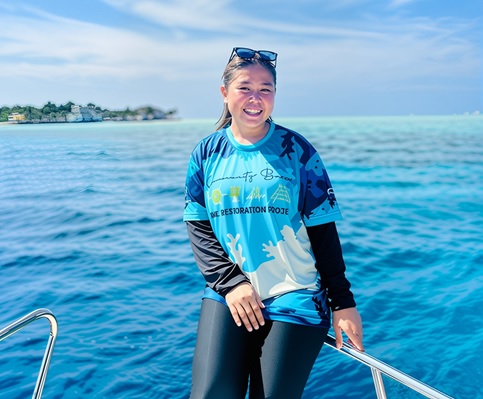
Mazni Jakarullah, a Larapan Island resident, hopes that conservation can go beyond just NGO work into a sustainable livelihood.
Her hope is that conservation can grow into a livelihood, not just sacrifice, with eco-tourism, coral farming and recycling initiatives as potential pathways.The Larapan recently launched a coral adoption programme to help fund restoration, and they have set up a basic waste management system that collects hundreds of kilograms of debris each month.
“Sometimes it is frustrating because the trash keeps coming back,” Mazni says. “But if we can find ways to add value to what we collect, things could change. We want conservation to support our lives as well as the sea.”
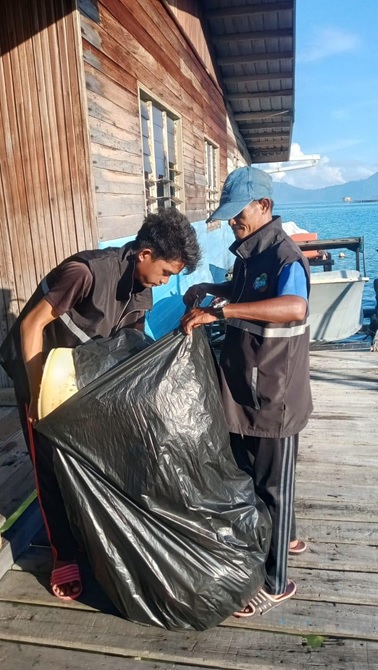
Appointed waste collectors on Larapan Island prep the day’s haul for the journey to the Semporna mainland.
Many islands, but a shared responsibility
On nearby Mabul Island, 24-year-old Nur Ayna Galib works with the Kelab Belia Iklim Mabul to collect and repurpose plastic waste into small souvenir items for tourists.
“For long-term sustainability, we want to create higher-value products from trash,” she says. “We want to show our community that waste does not have to be wasted.”
The challenge is cultural as much as environmental. Older villagers often see the sea as a source of immediate income. The youth see a longer horizon where healthy reefs secure future livelihoods.
Likewise, on nearby Kulapuan Island, 27-year-old Siti Rugaiyah Ghadafi continues conservation work mostly alone after many peers left in search of steady jobs. She also teaches 120 stateless children in a small community classroom.
“The allowance helps my family, but the work with the sea is about showing my community that we can live differently,” she says.
For Bajau Laut youth like Mazni, Nur Ayna and Siti, protecting the sea is not just activism, but preserving and saving their way of life.
Support begins with listening
Reef Check Malaysia has worked in Semporna for years, supporting community-led marine groups. For chief executive officer Julian Hyde, the core issue facing the islands is often misunderstood.
“People think the problem is plastic, but the communities are already sorting through the metals and other valuable recyclables, and you are left with the plastic,” he said.
On most islands, even drinking water comes in from Semporna in large five- or ten-litre bottles.
“There is no system to move waste off the islands. Everything has to be transported back to the mainland, and that costs money when the islanders have to count every ringgit and cent they earn,” he said.
At present, much of the waste management effort relies on short-term grants that pay for fuel, bags and occasional boat runs.
“But that is just a short-term solution. At some point, the grants and donations will end. NGOs can bridge gaps, help raise awareness and provide training.
“But sooner or later, someone has to step up to provide a proper, functioning municipal waste collection system,” Hyde said.
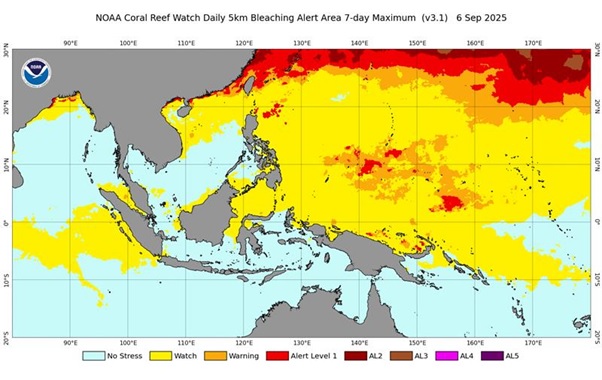
A screencap of the waters surrounding north Borneo and the Celebes Sea on heatwatch from the National Oceanic and Atmospheric Administration’s (NOAA) Coral Reef Watch. The yellow coloring on Sep 6 shows that reefs still face heat stress as the 4th Global Coral Bleaching Event still roils on. (Source: NOAA Coral Reef Watch)
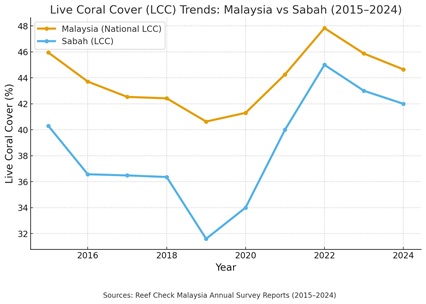
Reef Check’s monitoring work underscores why this matters. Its 2024 survey showed live coral cover falling from 45.9 percent to 44.7 percent nationwide, with bleaching recorded at nearly 90 percent of sites and declines in 63 percent of areas surveyed.
In Sabah, many reefs also show the scars of blast fishing, discarded nets and anchoring damage. Hyde warns that continued stress risks pushing reefs toward algae-dominated systems that support fewer fish and fewer livelihoods.
On coral restoration, Hyde is careful to draw a line between hope and illusion.
“Frames and nurseries can help small damaged areas recover, but they cannot restore an entire coastline,” he said, noting that the 2023–2024 marine heat event has slowed recovery in many places.
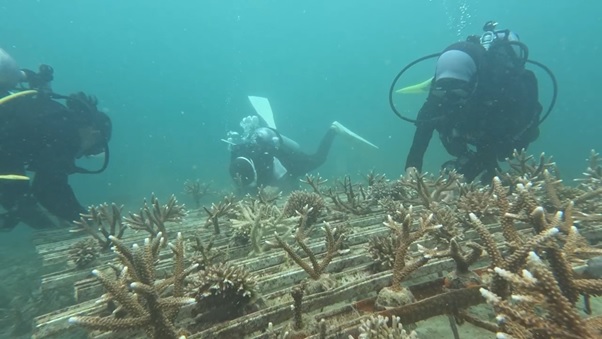
Mazni and her team doing work underwater. Although driven a genuine heart to care for the environment, she admits that passion alone cannot sustain these efforts forever.
Yet he also points to a signal visible in the data, comparing live coral cover numbers based on their annual survey from pre-, during, and post-pandemic surveys.
“When tourism paused during the pandemic, reefs in many places began to heal. The sea knows how to recover when given space. Our role is to respect the people who live with it and help them protect it, not tell them what to do.”
Envisioning the future
Another NGO working with Semporna’s island and coastal communities to reduce the waste problem is the World Wide Fund for Nature (WWF) Malaysia. Efforts with the communities in Omadal and Larapan to co-design waste management systems based around the realities of island life.
Aarston Friend Dickson, WWF-Malaysia’s Semporna-Darvel Bay Seascape Team Leader, said for waste management problems, the team has learned that plans work best when these are made on the island, rather than a distant office.
“We co-design from the start so the people can channel their vision, from scheduling collection day and simple sorting at home to ‘Plastic Rangers’ (local youths leading community change) on duty each week,” Aarston said.
With scheduled collection days and waste sorting on the community side, Semporna’s District Council – it’s local government, has also shown willingness to support current efforts on Mabul Island by co-funding transport and collection to ensure the island stays clean.
There will be a lot of work ahead, as the communities and local government are not just dealing with local waste, but waste from neighbouring countries, brought ashore by the tides.
Looking ahead, what would a clean, waste-free Semporna look like? Aarston describes a future that is not idealistic, but achievable.
“By 2035, Semporna’s ‘new normal’ is clean shores, healthy living reefs, and fisheries that feed families without emptying the sea, underpinned by sustainable, responsible tourism,” he envisioned.
Island waste plans in Omadal, Larapan, and Mabul would be endorsed, with a district by-law to set waste sorting at home, and published island collection calendars. Meanwhile, the district council’s budgets would include line entries to fund logistics, so that the waste transport boats and storage no longer need to depend on short-term grants, while buy-back programmes operate across Semporna district to promote recycling.
“Our community stewardship areas would be recognised as locally managed marine areas [where the rules for fishing and tourism are agreed on by the people who live there] or Other Effective Area-Based Conservation Measures [formally acknowledged by the government for their conservation value and are protected],” said Aarston said.
The Sabah government hopes that the combined efforts of agencies, NGOs, and local communities will pave the way toward a circular economy.
“One opportunity lies in building a circular economy by converting the tonnes of plastic waste in our ocean into usable products.”
“This is a simple yet brilliant idea, and if scaled up, it could significantly boost Sabah’s GDP while promoting sustainability,” said then-Deputy Chief Minister and Agriculture, Fisheries and Food Industry Minister Datuk Seri Dr Jeffrey Kitingan last year.
Delivering the keynote address at a conference on “Protecting Semporna’s Marine Environment from Plastic Waste and Fish Bombing”, Dr Kitingan added that the Bajau Laut, known for their deep maritime knowledge, should be recognised and empowered as guardians of Sabah’s marine resources, but added that this would provided the Bajau Laut communities are able to maintain more permanent settlements that allow for consistent delivery of education, livelihood, and conservation support.
At the same time, stronger protection mechanisms remain crucial.
More recently, Sabah Parks Director Datuk Dr Maklarin Lakim announced at the 3rd ASEAN Blue Economy Forum in October 2025 that Sabah plans to expand its marine protected areas from 7.4% to 13%, in line with the Kunming–Montreal Global Biodiversity Framework’s “30×30” global target.
Several new sites have already been identified for inclusion, Dr Lakim said, including Ligitan Island off Semporna.
The unseen cost of persistence
For Semporna’s youth, the ocean is both lesson and test. Each piece of plastic collected, each coral planted and each conversation with a sceptical elder is part of the slow work of changing how their communities relate to the sea.
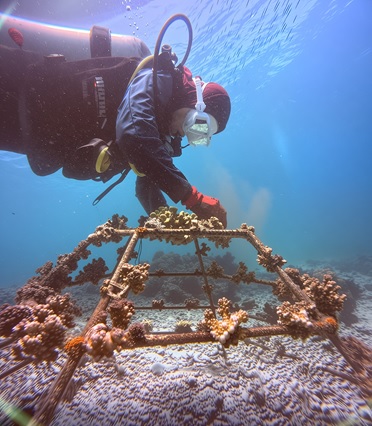
Siti on her routine dive. She is now the only one left in the action group as all others have gone elsewhere in search of a more sustainable source of income.
In the morning, Mazni and her team dive among reefs once shattered by explosions. Fish move through newly growing corals, proof that recovery is possible. On the surface, boats return from clean-ups with decks piled high with trash, a reminder of how much remains to be done.
“We just keep showing up when needed,” Mazni says. “Because if not us, who else?”
The work carries a cost. Many young activists sacrifice income, time and friendships. Siti has watched peers drift away. Mazni admits that fatigue comes easily and hope needs renewing.
Yet there are signs of change. In Larapan, Kulapuan and Mabul, more households are sorting waste, taking part in clean-ups and seeing the reef as something to protect. Coral adoption, recycling workshops and small eco-tourism efforts are helping stewardship take root.
For these youth, success is not just cleaner beaches but a shift in mindset. It is teaching that blast fishing destroys future livelihoods, and that caring for the sea can be part of daily life.
“We cannot save the world for free forever,” Siti says. “But maybe we can make saving it part of how we live.”
This story is supported by Internews’ Earth Journalism Network